Rust Never Sleeps: Managing Steels Lintels and Anchors
Some of the most important components of a masonry wall are also the ones you rarely see.
Steel lintels above windows and doors, shelf angles supporting masonry, and anchors connecting the exterior veneer to the structure all play an important role in keeping a building stable. Because much of this steel is concealed within the wall, deterioration can develop for years before the problem becomes obvious from the outside.
When moisture reaches these steel components, corrosion begins. What starts as a small amount of rust can eventually create enough pressure to crack, shift, or displace the surrounding masonry. Understanding the warning signs can help building owners and facility managers address corrosion before it develops into a much larger restoration project.
Why Steel Corrosion Creates Problems for Masonry
Steel and masonry can perform together for decades when properly designed and protected from moisture. Problems develop when water finds its way into the wall system and repeatedly reaches unprotected or aging steel.
As steel corrodes, rust forms on its surface. That corrosion occupies more space than the original steel. When the steel is confined behind brick, stone, or concrete, the expanding corrosion creates pressure against the surrounding material.
This condition is commonly referred to as rust jacking.
Eventually, the pressure can become strong enough to crack mortar joints, push masonry outward, or fracture individual masonry units. The resulting cracks then provide additional pathways for water to enter the wall, accelerating the corrosion process.
It can become a cycle: water causes corrosion, corrosion causes cracking, and cracking allows even more water into the wall.
Steel Lintels: A Common Trouble Spot
Steel lintels are commonly installed above windows, doors, and other wall openings to support the masonry above them.
Because these openings interrupt the wall, they can also be locations where water management becomes particularly important. Failed sealants, deteriorated mortar joints, inadequate flashing, or other defects can allow moisture to reach the lintel.
One of the most recognizable signs of lintel corrosion is cracking in the brick or mortar immediately above a window or door. In some cases, cracks may extend horizontally along the lintel. In others, they may radiate upward from the corners of the opening.
Other warning signs include:
- Rust staining on the masonry
- Flaking or peeling coatings on exposed steel
- Cracked mortar joints above openings
- Brick that appears lifted or displaced
- Bulging masonry
- Visible corrosion along the edge of the lintel
- Recurring cracks after previous masonry repairs
These symptoms should not automatically be treated as isolated masonry problems. The condition of the steel behind the masonry may be the actual cause.
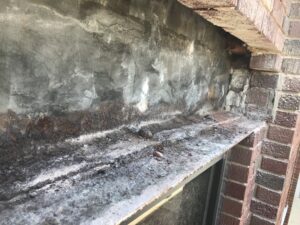
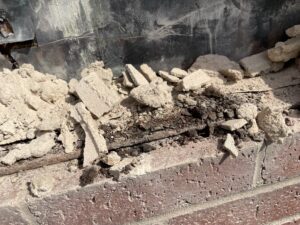
Shelf Angles Can Create Similar Damage
Shelf angles are horizontal steel members used to support sections of masonry veneer, particularly on taller buildings.
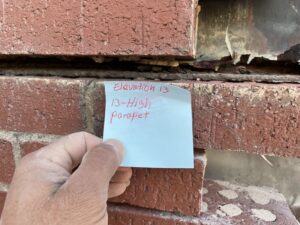
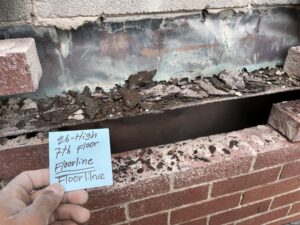
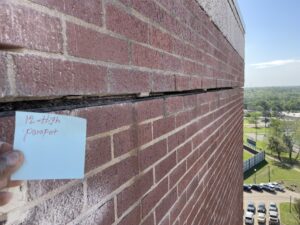
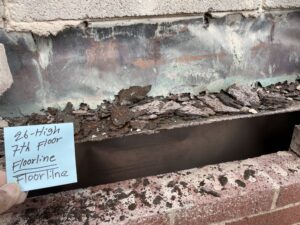
Like lintels, shelf angles can corrode when moisture enters the wall system. Because the steel is positioned directly behind the masonry, expanding corrosion can create horizontal cracking or displacement along the support line.
Expansion and movement must also be considered. Masonry and the supporting structure do not always move at the same rate. Properly designed joints allow that movement to occur without transferring excessive stress into the facade.
When corrosion, failed joints, or water intrusion are present, however, visible cracking along the shelf angle may indicate that a closer investigation is necessary.
What About Masonry Anchors?
Masonry anchors and wall ties serve a different purpose but are equally important.
In cavity wall construction, metal ties connect the exterior masonry veneer to the backup wall or structural system. Stone veneer systems may rely on similar anchors to keep individual pieces securely attached to the building.
Because these components are hidden inside the wall, corrosion can be especially difficult to detect.
As anchors deteriorate, they can lose cross-sectional strength or fail altogether. Depending on the wall system and the extent of the deterioration, the masonry may begin to bulge, move, crack, or separate from the backup structure.
Signs that may warrant investigation include:
- Areas of masonry that appear to bow or bulge
- Unexplained horizontal or vertical cracking
- Loose or displaced masonry units
- Sections of facade that move independently
- Repeated cracking after previous repairs
Because failed anchors can become a life safety concern, suspected anchor deterioration should be evaluated by qualified professionals. Structural engineers may also need to determine appropriate anchor types, locations, and spacing when repairs are required.
Repairing Corroded Steel
The appropriate repair depends on the location of the steel, how much corrosion has occurred, and whether the deterioration has affected its ability to perform structurally.
Cleaning and Coating Existing Steel
If corrosion is discovered before significant section loss has occurred, it may be possible to expose the steel, remove corrosion, and apply a protective rust-inhibiting coating.
The surrounding masonry can then be repaired or reconstructed.
But treating the steel alone is not enough. The source of moisture must also be addressed, or corrosion is likely to return.
Replacing Severely Corroded Lintels
When corrosion has significantly reduced the thickness or strength of a lintel, replacement may be necessary.
This typically requires removing enough masonry to safely access the steel, replacing the deteriorated lintel, and rebuilding the wall.
Galvanized or stainless steel may be considered where appropriate to provide improved corrosion resistance.
Installing Restoration Anchors
When existing masonry ties or anchors have deteriorated, restoration anchors can sometimes provide a solution without completely dismantling the wall.
These systems can be installed through the existing masonry and secured to the backup structure, restoring the connection between the veneer and the building.
The appropriate repair system should be selected based on the existing construction and the conditions discovered during investigation.
Fix the Water Problem, Not Just the Crack
One of the biggest mistakes in masonry repair is addressing visible cracks without asking why they developed.
Repointing a cracked mortar joint or replacing a damaged brick may improve the appearance temporarily, but if corroding steel remains behind the wall, the pressure will continue. Eventually, the crack is likely to return.
Long-lasting repairs require identifying and correcting the source of moisture.
That may involve:
- Repairing deteriorated mortar joints
- Replacing failed sealants
- Installing or repairing thru-wall flashing
- Correcting drainage problems
- Repairing damaged masonry
- Applying appropriate protective coatings
- Improving other water-management details within the facade
Controlling water is one of the most effective ways to slow future corrosion and extend the service life of the repair.
Regular Inspections Can Catch Problems Earlier
Corroded lintels and anchors rarely improve with time.
The earlier deterioration is identified, the more options building owners typically have for addressing it. A localized repair may be manageable when corrosion is limited. After years of continued water infiltration, that same area may require extensive masonry removal and structural steel replacement.
Routine facade inspections should include a close look at windows, doors, shelf angle locations, parapets, transitions, and other areas where steel may be located behind the masonry.
Pay particular attention to new cracks, rust staining, displacement, bulging, and changes from one inspection to the next.
Photographs are also valuable. Comparing conditions from year to year can reveal movement or deterioration that may otherwise be difficult to recognize.
Don’t Ignore What Is Happening Behind the Wall
Rust may develop slowly, but the damage it creates can become significant.
A small crack above a window may be the first visible indication of a corroding lintel. Bulging masonry may point to deteriorated anchors. Rust staining may reveal a water-management problem that has been developing behind the facade for years.
The important thing is to identify the cause before simply repairing the symptom.
At Mid-Continental Restoration, we help building owners, facility managers, architects, and engineers investigate masonry deterioration and develop repair strategies that address both the visible damage and the conditions behind it.
If you are seeing cracking, rust staining, displaced masonry, or other signs that hidden steel components may be deteriorating, it is worth taking a closer look before corrosion turns a localized repair into a much larger project.